Case Study
Six neurodegenerative diseases.
One iron mechanism.
A systems biology investigation into iron-driven cell death, a process only named in 2012, and why it keeps appearing across Alzheimer's, Parkinson's, ALS, MS, Long COVID, and prion disease, connecting evidence that no single field had pieced together.
Solo project · Research, ODE modeling, design & build · Jan – Mar 2026
View Project (opens in new tab)The Problem
In 2012, a team at Columbia named a new form of cell death: ferroptosis, driven by iron-dependent lipid peroxidation. Distinct from apoptosis, necrosis, and autophagy. Within a decade, researchers found ferroptosis signatures in Alzheimer's, Parkinson's, ALS, MS, and other neurodegenerative diseases.
But each field studied it in isolation. Alzheimer's researchers focused on amyloid, Parkinson's on alpha-synuclein, ALS on TDP-43. Every group documented iron dysregulation in their disease. Nobody asked why the same iron-driven mechanism kept appearing across all of them.
Part of the reason is technical. No specific in vivo biomarkers for ferroptosis exist yet. Current brain imaging (QSM, R2*) detects bulk iron levels but can't resolve cellular-level distribution or distinguish iron species. You can't tell whether iron is safely stored in ferritin or free and reactive. Techniques like APART-QSM are only beginning to separate these signals.
A mechanism that may underlie multiple neurodegenerative diseases has been hiding in plain sight because the tools to see it clearly don't yet exist.
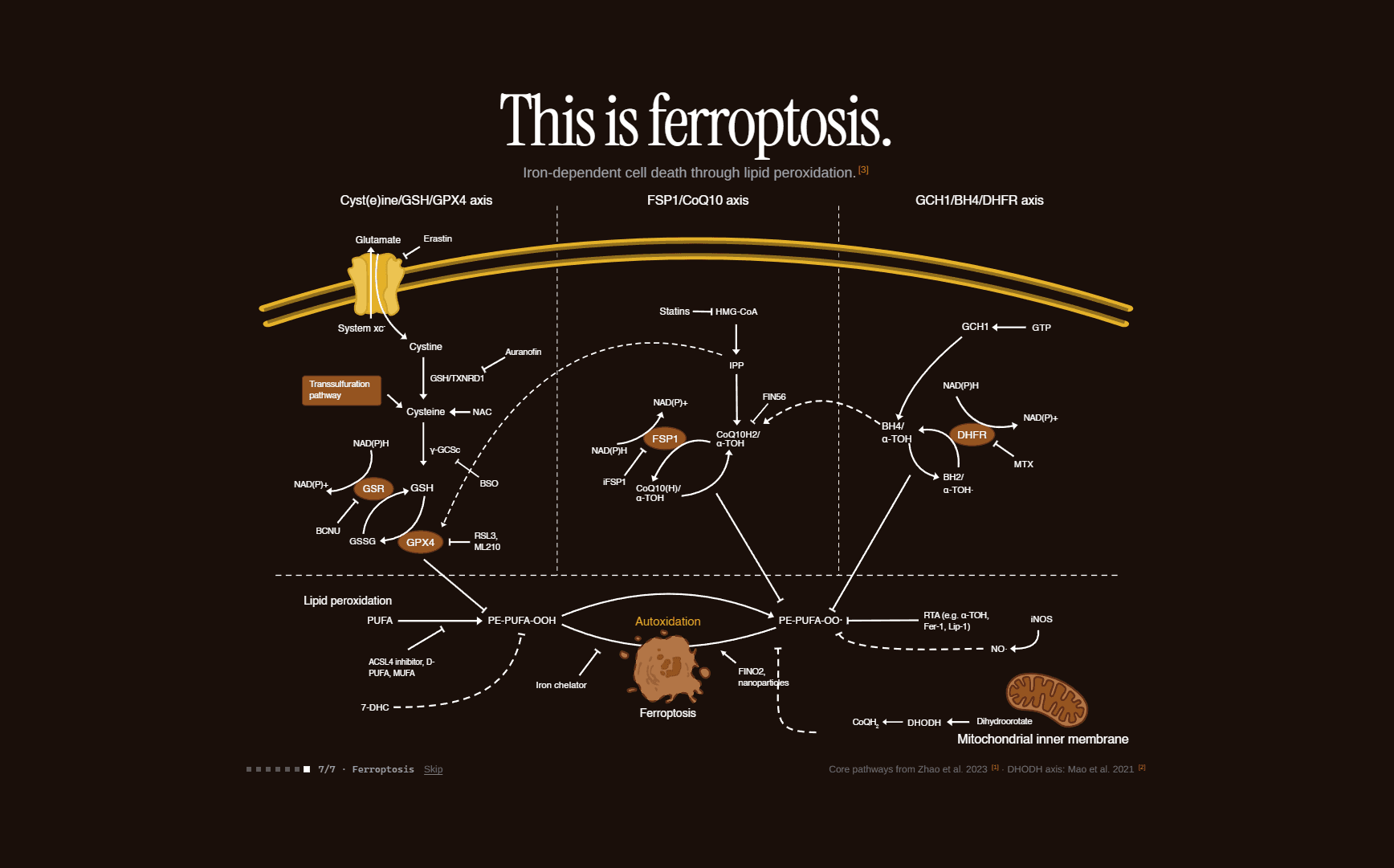
Different doors, same room.
How I Got Here
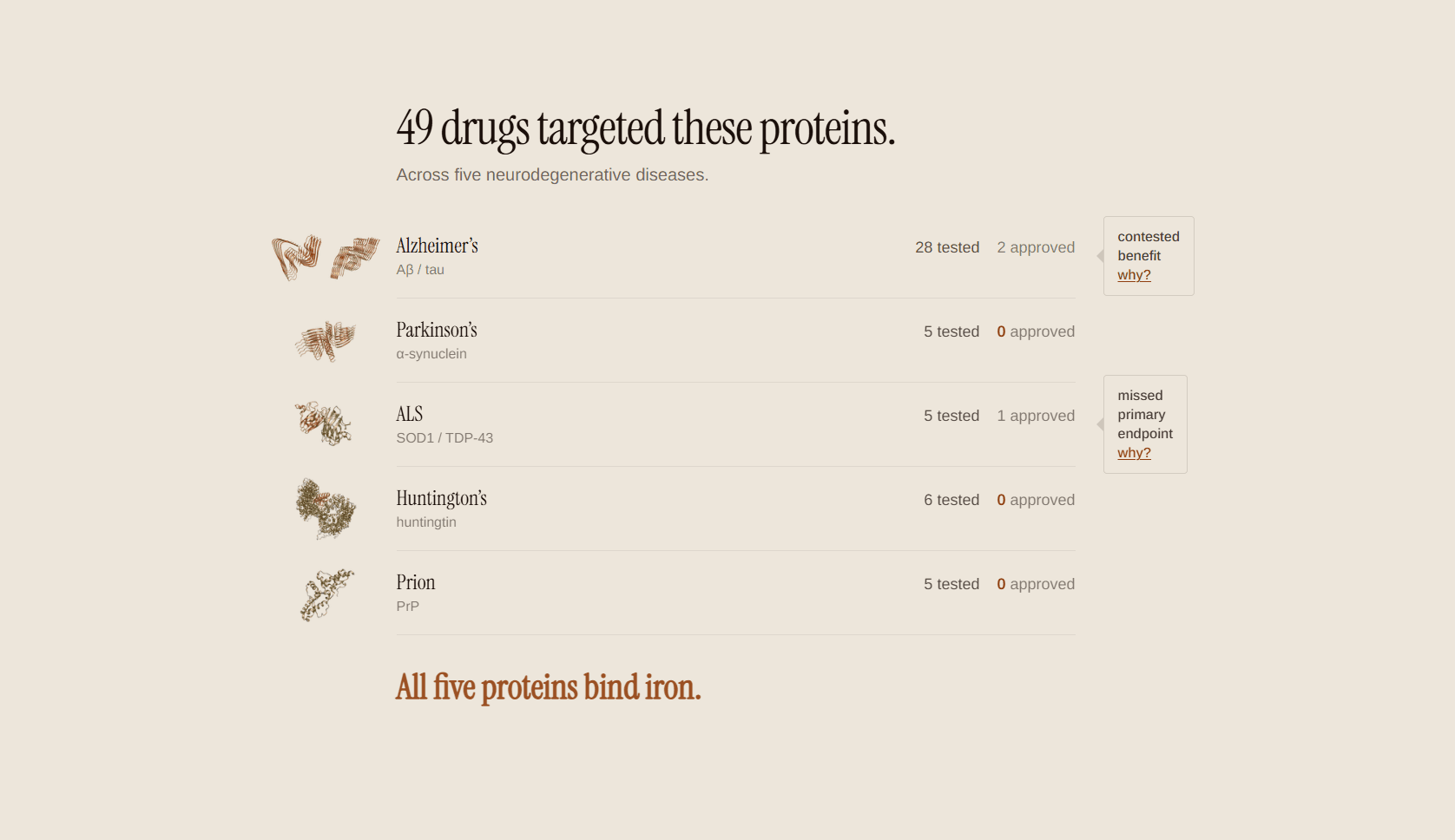
My entry point was Alzheimer's. During my Master's in Bioinformatics, I studied neuroimmunology and spent my final project on BACE1, one of the key enzymes in amyloid processing. After graduating, I watched five separate BACE1 inhibitor trials fail to improve cognition, with several worsening outcomes. That pattern pointed me away from amyloid clearance as a primary target and toward what might be upstream.
That failure is what led me to ferroptosis. If amyloid plaques weren't the cause, what was upstream? The emerging ferroptosis literature offered an answer: iron-driven lipid peroxidation damaging cells before plaques even form. But the more I read, the more I noticed something the individual disease communities weren't seeing.
The same ferroptosis signatures kept appearing across Parkinson's, Long COVID, ALS, MS, and prion disease — six diseases entering through different defense layers but converging on the same iron-driven cascade. That convergence is what FELINES maps: why the same cascade produces different clinical presentations depending on which layer fails first.
The Approach
Most neurodegeneration research focuses on correlation within a single discipline. I wanted to untangle causation across many, pulling evidence from fields that rarely talk to each other in this space and seeing what patterns emerge when you read them together.
Conventional focus
Where FELINES diverges
How Each Field Contributed
Toxicology
Used poison models as natural experiments to isolate specific mechanisms. BZ (a cholinergic toxin) showed how disrupting one system cascades into iron dysregulation. SUR1-TRPM4 channel blockers showed neuroprotective effects through ion homeostasis. Gulf War Illness, where soldiers were exposed to multiple agents simultaneously, provided a real-world case study of how combined insults overwhelm defense layers that handle individual toxins fine.
Comparative Biology
Chimpanzees develop amyloid plaques identical to humans but never progress to Alzheimer’s pathology. This is one of the strongest pieces of evidence that plaques alone don’t cause disease. The difference: chimps have different iron handling in the brain. If plaques were the cause, chimps should get Alzheimer’s too.
Clinical Neurology
Hepatic encephalopathy causes neurodegeneration without plaques or tangles, proving protein aggregation isn’t required. The mechanism: liver failure floods the brain with manganese (which competes with iron transport), disrupting the same iron-handling systems FELINES maps. Different entry point, same downstream cascade.
Genomics & GWAS
Iron genes don’t appear directly in genome-wide association studies for Alzheimer’s. But genes that increase susceptibility to iron damage do: APOE4 (impairs iron buffering), HFE H63D (damages white matter in healthy carriers but paradoxically protects it in APOE4 carriers), and genes regulating ferroportin and hepcidin signaling. The iron signal is there if you know what to look for.
Crystallography
Analyzed crystal structures of amyloid-beta and tau to identify where iron binds. The His13 residue on human amyloid-beta binds iron more tightly than its mouse equivalent, explaining why mouse models translate so poorly. This structural difference means drug candidates that work in mice are tested against a fundamentally different iron-binding geometry.
Bioinformatics
Ran experiments on the SEA-AD (Seattle Alzheimer’s Disease) single-nucleus RNA-seq dataset to examine iron-handling gene expression changes at the cellular level. Found that different cell types show opposite iron responses: neurons upregulate iron import (starving) while surrounding glia accumulate iron (overloaded). Both happen in the same tissue, invisible to bulk measurements.
Epidemiology
Traced how occupational and environmental iron exposures correlate with neurodegeneration risk across populations. Welders, miners, and populations near industrial iron sources show elevated rates. Combined with the genetic susceptibility data, this pointed to iron as a convergent environmental trigger across diseases.
Questioning Inflammation
Early in the research, inflammation looked like the obvious starting point. Source after source placed it at the top of the causal chain: microglia activate, inflammatory cytokines rise, neurons die. The narrative was clean and widely cited.
But the clinical trial record told a different story. The ADAPT trial testing naproxen and celecoxib in Alzheimer's prevention was halted early. The treatment group trended worse. INTREPAD, testing naproxen in at-risk populations, found no benefit. Prednisone, rofecoxib, indomethacin, tarenflurbil, ibuprofen. Every major anti-inflammatory trial in Alzheimer's either failed outright or made outcomes worse.
That pattern forced a harder question: what if the causal arrow points the other way? The ferroptosis literature provided the mechanism. When cells die by ferroptosis, they release damage-associated molecular patterns (DAMPs) such as HMGB1, ATP, and oxidized lipids, which activate the NLRP3 inflammasome and recruit inflammatory responses. Ferroptosis is more immunogenic than apoptosis. The inflammation researchers were documenting was real, but it was substantially a consequence of upstream cell death, not its cause.
This doesn't mean inflammation plays no role. The consensus recognizes a bidirectional cycle where inflammation and cell damage amplify each other. But the trial failures suggest that targeting inflammation alone can't break the cycle. The upstream driver, iron-dependent lipid peroxidation, has to be addressed first.
Cells are starving while surrounded by iron.
Neurodegenerative brains show high total iron on MRI, yet individual cells are iron-starved, upregulating transferrin receptors and iron-response proteins. Both are true because iron gets trapped where cells can't access it.
The Model
The model started as “PLIG”, a working acronym for pericytes, lysosomes, iron, and glia. As the model crystallized, the name evolved into FELINES: Fe (Iron Homeostasis) · Lysosome/Antioxidant · Immune/Inflammatory · Neurovascular · Export · Sheathing. It also reads as Fe + LINES, the main driver and what sets it in motion.
Iron Homeostasis
Systemic iron homeostasis, hepcidin signaling, transferrin saturation, and cellular import/export balance.
Lysosome/Antioxidant
Ferritin sequestration, lysosomal iron recycling, and GPX4/glutathione antioxidant defense. The cell's internal buffering against free iron and lipid peroxidation.
Immune/Inflammatory
Microglial activation, NLRP3 inflammasome signaling, and the bidirectional cycle where ferroptotic cell death triggers inflammation that amplifies further damage.
Neurovascular Barrier
Blood-brain barrier integrity maintained by pericytes and astrocyte endfeet, the gatekeeper against serum iron.
Export
Ferroportin-mediated iron export and ceruloplasmin oxidase activity. The cellular mechanism for removing excess iron before it catalyzes damage.
Sheathing
Myelin sheath integrity maintained by oligodendrocytes, the highest-iron cells in the brain at 3.05 mM. The structural insulation whose failure exposes axons to iron-driven damage.
When one defense layer fails, the others compensate. When multiple layers fail at once, the system collapses. This explains why some people with amyloid plaques never develop dementia (their other layers compensate) and why single-target drugs keep failing.
The interactive iron clearance model simulates how the brain clears iron over a lifetime and why that process fails in neurodegeneration. A 3-state ODE system (labile iron pool, ferritin stores, interstitial fluid) solved with 4th-order Runge-Kutta integration tracks when ferroptosis thresholds are crossed under different genetic and clinical conditions.
Designing for Two Audiences
The FELINES model started life as a massive research document, comprehensive but nearly impossible to communicate. Before touching a single layout, I studied how the best teams solve this exact problem.
Design References
realfood.gov (opens in new tab)
Complex nutrition policy made navigable without dumbing it down.
Grow by Ginkgo (opens in new tab)
Ginkgo Bioworks' editorial platform. Deep biotech with magazine-grade art direction and pacing.
The Pudding (opens in new tab)
Scroll-driven visual essays where the graphic is the narrative.
Quanta Magazine (opens in new tab)
Custom illustrations, interactive explainers, and bespoke feature layouts for science journalism.
Distill.pub (opens in new tab)
Reactive diagrams and explorable figures that let readers build intuition.
Stripe Press (opens in new tab)
Meticulous typography and scroll-driven presentation as art object.
Boulder Group (opens in new tab)
Bold typography and directional symbolism that treat complexity as an asset.
The throughline: complex information doesn't require a complex interface. That principle shaped the FELINES presentation.
Main Presentation
Reads like a narrative slideshow: problem, insight, evidence, implications. Each section is self-contained with a clear takeaway. A general audience can follow the entire story without a biology background.
Explore Mode
Branches into deep-dive pages on barrier architecture, disease-specific profiles, clinical trial analysis, and biological mechanisms. Researchers can drill into primary sources and detailed evidence.
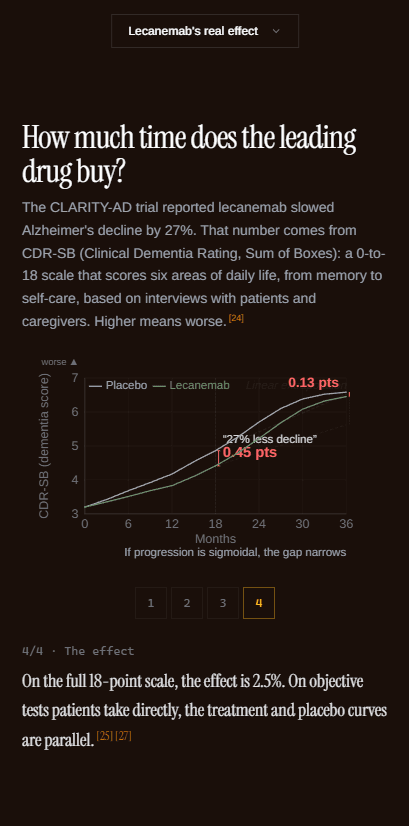
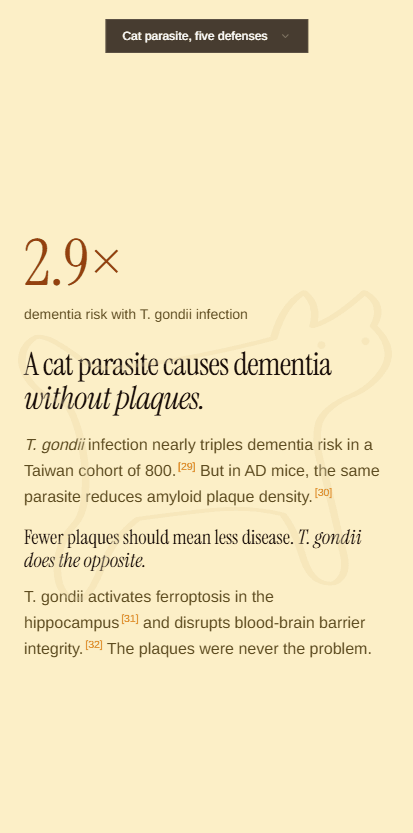
Presentation Flow
The iron clearance visualizations let users explore clinical scenarios or tune individual parameters to see how clearance failure unfolds differently. Built with Recharts, four synchronized charts show compartment levels, ferroptosis phase timeline, clearance pathway decline curves, and cell-type ferroportin export budget. Every parameter is classified as measured, derived, or assumed, with color-coded source indicators and citations.
A custom citation system with hover tooltips lets readers verify claims without leaving the page. Every major claim links to a primary source with DOI and PubMed references, each tagged with a verification status.
What I Learned
I learned to look across fields instead of deeper into one.
Each discipline studying neurodegeneration had a piece of the answer, but no single field had the full picture. Toxicology had the iron data, crystallography had the binding geometry, genomics had the risk variants. The insight came from reading laterally across all of them instead of going deeper into any one.
I learned that making research navigable is harder than doing the research.
The cross-disciplinary synthesis took months. Making it understandable to someone encountering it for the first time took longer. Every information architecture decision determined what a reader could discover versus what stayed buried. I rewrote the presentation flow three times before the narrative carried someone from zero context to the full model.
I learned to design for two audiences with the same content.
A general reader needs a guided narrative. A researcher needs to explore freely and check sources. Building both modes from the same underlying data forced me to separate content structure from presentation, which made both experiences better. The explore mode caught errors in the main narrative because researchers could see claims the narrative had simplified.
Built with